Most “best B2B SaaS marketing agency” lists are written by agencies ranking themselves first and padding the rest with filler. You know it. I know it.
This one is different, but I’ll be transparent about the bias upfront: I run Growigami, and yes, we’re on this list. But I’ve also hired agencies, fired agencies, and competed against several of them for deals. Every review below includes real pricing ranges, actual strengths, and honest weaknesses. No affiliate links. No paid placements.
If you’re a B2B SaaS founder or marketing leader evaluating agencies, this is the guide I wish existed when I was in your shoes.
The average B2B SaaS company is spending around 9.1% of revenue on marketing right now, according to Gartner’s latest CMO spend data. That’s a meaningful chunk of your budget to hand to an outside team. And yet most founders I talk to pick their agency based on a single referral or whoever had the slickest sales deck. That’s a six-figure decision being made on vibes. You can do better.
Quick Comparison: Top B2B SaaS Marketing Agencies in 2026
| Agency | Best For | Starting Price | Key Strength |
|---|---|---|---|
| Growigami | Full-service SaaS marketing + fractional CMO | $5,000/mo | Execution speed, founder-led |
| Kalungi | Series A/B companies wanting structured methodology | $15,000/mo | T2D3 framework, process depth |
| Directive Consulting | Enterprise SaaS with $50K+/mo budgets | $10,000/mo | Performance marketing, paid media |
| Refine Labs | Demand gen transformation, dark social | $15,000/mo | Demand gen philosophy, content |
| Powered By Search | Canadian SaaS, mid-market B2B | $10,000/mo | Predictable pipeline methodology |
| Bay Leaf Digital | Smaller SaaS ($1-10M ARR) | $5,000/mo | Analytics-driven, accessible pricing |
| Ironpaper | B2B lead gen, HubSpot-centric | $7,500/mo | Lead gen systems, HubSpot depth |
| Omniscient Digital | Content and organic growth | $10,000/mo | Long-form content, SEO strategy |
| Lean Labs | Website redesign + growth | $10,000/mo | Growth-driven design, CRO |
| SimpleTiger | SaaS SEO and content | $5,000/mo | SaaS-specific SEO, speed |
How We Evaluated These Agencies
No black-box scoring model here. Just the five things that actually matter when you’re writing checks.
SaaS specialization. Do they primarily serve B2B SaaS companies, or do they work with everyone and slap “SaaS” on their website? We looked at client rosters, case studies, and language. If their portfolio includes dentists and DTC brands alongside SaaS logos, that tells you something.
Pricing transparency. Can you get a ballpark without sitting through a 45-minute discovery call? Agencies that hide pricing entirely are usually expensive, inflexible, or both.
Execution breadth vs. depth. Some agencies do one thing well. Others attempt everything. Neither is inherently better, but you need to know which you’re getting before you sign.
Real client results. Published case studies with actual numbers. Pipeline generated, traffic growth, conversion rates. Not just logos on a landing page and a quote that says “they really understood our business.”
Team structure. This is the one most people skip, and it matters more than anything. Do you work with senior strategists, or get handed off to a junior account manager three weeks after signing? I looked at Glassdoor reviews, LinkedIn team sizes, and talked to founders who’ve been through engagements with these agencies.
One thing I’ve noticed after seven years of doing this: the number of agencies claiming SaaS specialization has exploded, but the number with genuine depth hasn’t moved much. Most “SaaS agencies” are general agencies that added a SaaS landing page in 2023. The tell is always the case studies. If every result is a traffic metric and none are pipeline or revenue, you’re looking at a content shop with SaaS branding.
The 10 Best B2B SaaS Marketing Agencies in 2026
1. Growigami
Full disclosure: This is our agency. I’m including us because we belong on this list, but I’ll hold us to the same standard as everyone else. Probably harder, honestly, because I know where the gaps are.
Some backstory, because it matters here: I spent four years at Kalungi (2019-2023). Joined as one of their first Marketing Leaders running fractional CMO engagements, sold new business, supported their clients, sat on the leadership team, and eventually became CRO. I have a lot of respect for what they’ve built and I learned how SaaS marketing agencies actually work from the inside. But over those four years I kept seeing the same thing: SaaS companies that genuinely needed marketing leadership but couldn’t stomach $15K-$20K/mo agency fees. Capital was getting expensive, SaaS wasn’t printing money the way it was in 2020-2021, and founders needed someone scrappier and more hands-on than the traditional agency model could deliver. So Bruno and I left to build Growigami.
We’re a full-service B2B SaaS marketing agency and fractional CMO practice. We work with SaaS companies from seed stage through Series C, handling everything from positioning and messaging to content, paid media, SEO, email sequences, and RevOps. 40+ clients across fintech, insurtech, HR tech, transportation tech, and developer tools.
The biggest difference from where I came from: we run AI-native processes instead of the traditional agency playbook where everything takes three weeks and four rounds of review. We’re a small, senior team. You work directly with the founders. No junior account managers reading from a script. We embed in your Slack, attend your standups, and operate as part of your team. The trade-off is capacity. We cap clients, which means we sometimes turn away great companies because the bench is full.
Best for B2B SaaS companies ($1M-$50M ARR) that need a full marketing function without hiring a VP of Marketing plus a team. Especially strong for technical founders who need a marketing partner who can translate product complexity into pipeline.
Services include fractional CMO and marketing strategy, SEO and content marketing (blog, pillar pages, programmatic), paid media (Google, LinkedIn, Meta), email sequences and outbound, LinkedIn ghostwriting for founders, website strategy and conversion optimization, brand positioning and messaging, and marketing analytics and attribution.
Pricing: $5,000-$15,000/mo depending on scope. Full-service engagements typically land at $8,000-$12,000/mo. No long-term contracts. Month-to-month because we’d rather earn the renewal than lock you in.
Where we’re strong: Founder-led execution, full-stack delivery from strategy through implementation, fast turnaround (content goes live in days, not weeks), deep SaaS experience across multiple verticals, and transparent pricing published on our website.
Where we’re not: Small team means limited capacity. Not ideal for enterprise SaaS with $100K+/mo marketing budgets. Less brand recognition than larger agencies. And if you want a rigid, certified framework with badges and certifications, that’s not us.
40+ B2B SaaS clients across insurtech, fintech, HR tech, transportation tech, and developer tools.
2. Kalungi
Full transparency: I spent four years here (2019-2023). Joined as one of their first Marketing Leaders, ran client engagements as fractional CMO, sold new business, sat on the leadership team, and eventually became CRO. So I know this company from the inside, not from a sales deck.
Kalungi is built around their T2D3 framework, a methodology for tripling revenue twice, then doubling it three times. They’re a HubSpot Diamond Partner with 150+ SaaS clients, and they position themselves as the outsourced marketing department for B2B SaaS companies. Their approach is deeply systematized: audit, strategy, execution, optimization, each with defined phases. They have a real bench of specialists and a clear track record taking SaaS companies from $1M to $10M+ ARR.
What I’ll say from having been on the inside: the process depth is real. When the framework fits your company, it works extremely well. Where I saw friction was with founders whose go-to-market didn’t map cleanly to T2D3. The methodology can feel rigid when your situation calls for something the playbook doesn’t cover. That’s not a flaw, it’s a trade-off. Structure and flexibility are usually in tension.
Best for Series A/B SaaS companies ($2M-$20M ARR) that want proven methodology and are willing to pay a premium for process depth. Works well for companies that don’t have a marketing leader and need the agency to completely fill that gap.
Starting around $15,000/mo for full-service. Their fractional CMO services run $10,000-$20,000/mo depending on scope. Premium pricing, but you’re paying for the size of the team and the systematization.
What they do well: The T2D3 framework gives you a clear, repeatable methodology. Large team with deep specialist benches. HubSpot Diamond Partner, which matters if you’re in that ecosystem. 150+ SaaS clients means they’ve seen most go-to-market patterns. Strong thought leadership content about SaaS marketing.
What to know going in: Premium pricing puts them out of reach for early-stage startups. The framework rigidity is real, not just my opinion. If your go-to-market doesn’t fit T2D3, you’ll spend time forcing it. Their own content marketing is heavily self-promotional (their blog ranks for “best SaaS agencies” partly because they wrote themselves into every list, which, yes, I’m aware of the irony here). The certification-heavy marketing (“T2D3 certified,” “SaaS Marketing Playbook certified”) can feel like theater. HubSpot-centric approach may not suit companies on Salesforce or Pipedrive. And with a larger team, you may not always work with their strongest people.
Published case studies include companies like Beezy, Fraxion, and GUIDEcx. Client roster is predominantly seed-to-Series B SaaS.
3. Directive Consulting
We competed against Directive for a deal last year. Lost. The founder chose them because their paid media operation is genuinely best-in-class and the company had the budget to take advantage of it.
Directive is a performance marketing agency focused on SaaS and tech. They’ve built their reputation on paid media with a heavy emphasis on what they call Customer Generation, their methodology for aligning paid campaigns to actual revenue instead of just lead volume. They operate at a larger scale than most agencies on this list. About 200 people. Their sweet spot is SaaS companies spending $50K+ per month on ads, where optimizing cost-per-pipeline and CAC has a measurable impact on unit economics.
Best for mid-market to enterprise SaaS ($10M+ ARR) with established paid media programs that need serious optimization, or companies ready to invest heavily in paid acquisition.
Starting around $10,000/mo, but typical engagements run $15,000-$30,000/mo. If your total marketing budget is under $20K/mo, Directive probably isn’t the right fit and they’ll likely tell you that themselves.
What they do well: Paid media expertise for SaaS is legitimately top-tier. The Customer Generation methodology ties spend to revenue, not vanity metrics. Strong creative team for ad production. Analytics and reporting are genuinely strong. Deep specialist benches across a large team.
What to watch for: Expensive, full stop. Not practical for seed or early Series A. They’re a paid-media-first shop, so if you need content, brand, or organic growth as your primary channel, the fit is off. At 200 people, account manager quality varies. I’ve heard great things and I’ve heard “my AM just reads dashboards back to me on calls.” Their SEO and content services exist but aren’t their core strength. Long-term contracts are common.
They work with companies like Adobe, Amazon, ZoomInfo, and Sumo Logic. Much heavier on enterprise logos than early-stage SaaS.
4. Refine Labs
Refine Labs gained prominence under Chris Walker, championing the demand generation movement and popularizing “dark social,” the idea that B2B buyers actually discover products through untrackable channels like podcasts, Slack communities, and word of mouth. Their core thesis: most B2B marketing over-invests in lead capture and under-invests in demand creation.
A founder I know switched from Refine Labs to us. What she told me: “They completely changed how we think about marketing measurement, and that was worth the price of admission alone. But when it came to actually executing campaigns and generating pipeline on a timeline, we needed something faster.” That’s the Refine Labs trade-off in a nutshell. The thinking is brilliant. The execution timeline is long.
Even as the agency has evolved post-Walker, the philosophical foundation remains strong. If your marketing is stuck in the “gate everything, score every lead, hand to SDRs” trap, Refine Labs can help you rethink the entire approach.
Best for B2B SaaS companies ($5M-$100M ARR) that are frustrated with traditional demand gen and want to shift to a demand creation model.
Starting around $15,000/mo for full engagements. Can run $20,000-$40,000/mo. They have a more accessible strategic advisory offering at $5,000-$10,000/mo if you want the thinking without the full execution.
Why founders love them: Strongest philosophical framework for modern B2B demand gen. Excellent at reframing how companies think about measurement. Strong content and social media execution. Real podcast-as-a-channel expertise. Very effective for companies selling to marketers, which is meta but true.
The honest downsides: The “dark social” thesis, while valuable, can conveniently justify any channel that’s hard to measure. Premium pricing without traditional short-term ROI metrics is hard to sell to your board. Works best for companies already doing $5M+ ARR because early-stage companies need pipeline now, not philosophy. Chris Walker’s departure reduced brand gravity, though the team remains capable. Less effective for companies with short sales cycles or PLG motions.
They’re selective about publishing client names. Mostly B2B SaaS in marketing tech and sales tech verticals.
5. Powered By Search
Dev Basu’s team in Toronto. They’ve been doing B2B SaaS marketing since before it was a category people optimized LinkedIn posts about.
What sets them apart is their focus on the middle of the funnel, the messy space between “someone visited your website” and “someone booked a demo.” Most agencies obsess over top-of-funnel traffic or bottom-of-funnel conversion. Powered By Search tries to own the full journey, and their “Predictable Pipeline” methodology reflects that.
I have a lot of respect for Dev’s approach. His thought leadership is substantive. He actually says useful things instead of repackaging obvious advice with a “here’s my controversial take” hook.
Best for mid-market B2B SaaS ($5M-$50M ARR), particularly those based in Canada or serving Canadian markets. Also a strong choice for companies that have tried other agencies and felt like they got “traffic but no pipeline.”
Pricing starts around $10,000/mo. Typical engagements run $12,000-$25,000/mo.
They cover full-funnel strategy, paid media (Google, LinkedIn), SEO and content, CRO, marketing ops, and ABM. The full-funnel approach is genuinely differentiated. Long track record in B2B SaaS, not a rebrand from a general agency. Strong paid media plus SEO combination.
Smaller team means capacity constraints. Less well-known in the US market. ABM capabilities are developing but not as mature as dedicated ABM agencies. Toronto time zone can be a minor friction point for West Coast companies, though I’ve never heard anyone call it a dealbreaker.
6. Bay Leaf Digital
Bay Leaf is the agency I recommend when a founder tells me their total marketing budget is $8K/mo and they need to make every dollar count.
Texas-based, analytics-driven, focused on smaller SaaS companies that can’t justify $15K+/mo agency fees. Their approach is pragmatic. They build marketing programs around data and revenue attribution, not brand fluff. For early-stage SaaS, Bay Leaf hits a sweet spot: experienced enough to avoid the rookie mistakes that cost you quarters of wasted spend, but priced accessibly enough that you’re not betting the company on agency fees.
Starting around $5,000/mo, with typical engagements running $5,000-$12,000/mo. One of the most accessible agencies on this list.
They handle SEO, content, paid media (Google, LinkedIn), analytics and dashboarding, social, email, and strategy. The analytics focus is real. You see exactly what’s working, which at this price point matters because you can’t afford to burn budget on channels that aren’t converting.
Limitations are real too. Smaller team limits breadth. Less strategic depth than premium agencies. More execution-focused. Content production quality can be inconsistent. Not ideal for complex enterprise sales cycles. Limited creative and design capabilities. But if you’re a bootstrapped SaaS founder doing $3M ARR and you need competent, affordable marketing execution, this is a strong option.
7. Ironpaper
New York-based B2B growth agency. HubSpot Partner. Their whole thing is the mechanics of lead gen: landing pages, email sequences, lead scoring, nurture workflows.
If your marketing generates traffic but doesn’t convert it into pipeline, Ironpaper is built to fix that specific problem. They’re not trying to reinvent your brand or rethink your go-to-market. They’re plumbers. Good plumbers. They find where the leads are leaking and they fix the pipes.
Starting around $7,500/mo. Full-service engagements run $10,000-$20,000/mo.
What works: Deep HubSpot expertise. Strong conversion focus. Systematic approach to lead gen and nurture. Good at building repeatable programs. East Coast time zone alignment.
What doesn’t: HubSpot-centric, so if you’re on Salesforce or Pipedrive, the fit degrades. Lead gen focus can default to gated content strategies that produce MQLs, not pipeline, which is the exact problem you were trying to solve. Creative work is functional, not inspired. More tactician than strategist. Pricing can creep up with add-on services.
They work primarily with mid-market B2B technology companies and publish case studies with specific lead gen and conversion metrics.
8. Omniscient Digital
Co-founded by Alex Birkett and David Ly Khim. They do one thing and they do it extremely well: high-quality, long-form content for B2B SaaS companies.
Omniscient doesn’t try to be a full-service agency. They’re a content and organic growth shop. Period. If your primary growth lever is organic content and you need a team that can produce consistently high-quality output at volume without it reading like it came from a content mill, Omniscient is one of the strongest options out there.
The founders are active practitioners with real track records, not agency owners who stopped doing the work five years ago. That matters because content quality starts at the top.
Starting around $10,000/mo. Typical engagements run $10,000-$20,000/mo. That’s premium for a single-channel agency, but reflects that they use experienced SaaS writers.
The upside is clear: Best-in-class content quality for B2B SaaS. Content production at scale without sacrificing quality. Strong SEO technical knowledge. Good at translating complex SaaS products into compelling content.
The trade-off is equally clear. Content and SEO only. You’ll need other partners for paid media, email, design, everything else. If you need pipeline in 30 days, organic content won’t deliver that. Smaller team means queue times can extend during peak periods.
They work with SaaS companies like Jasper, AppSumo, and Loom.
9. Lean Labs
Lean Labs operates on a thesis I agree with: your website is your best salesperson, and most SaaS websites are terrible at their job.
Unlike traditional design agencies that deliver a website and disappear, Lean Labs uses an iterative approach. They launch a “Minimum Viable Website” quickly, then continuously optimize based on performance data. It’s growth-driven design, not the old “spend six months on a redesign, launch it, then don’t touch it for two years” model.
Starting around $10,000/mo for ongoing engagements. One-time website projects can run $30,000-$80,000.
Best for SaaS companies ($3M-$30M ARR) that know their website is underperforming, or companies whose conversion rate is below 2% and want systematic CRO.
Strong portfolio of SaaS website redesigns. The iterative methodology avoids the “big redesign then nothing” trap. Genuine CRO expertise.
The limitations: website and CRO focused, so you need other partners for content, paid, email. Ongoing engagement model means higher total investment over time. HubSpot CMS focus may not work if you’re on WordPress or Webflow. And if your traffic volume is too low for statistically significant A/B testing, you won’t get the full value of their optimization approach.
10. SimpleTiger
SimpleTiger is a SaaS-focused SEO and content agency that competes on speed. While many SEO agencies operate on 6-12 month timelines before showing any results, SimpleTiger pushes for quick wins, identifying opportunities where small technical fixes or content updates can drive meaningful traffic improvements within weeks.
Starting around $5,000/mo. Typical engagements run $5,000-$15,000/mo. One of the more accessible options for focused SEO work.
Best for SaaS companies ($2M-$30M ARR) that want focused SEO without the overhead of a full-service engagement. Particularly good for companies that have tried SEO in-house and hit a plateau.
They understand product-led, bottom-of-funnel content. Fast execution. Accessible pricing relative to results. Lean team means you work with senior people. They work with SaaS companies including JotForm, Segment, and Bidsketch.
A caveat on the “quick wins” approach: it’s great for the first few months, but quick wins eventually run out. The question is whether they transition into building the long-term content moat you need, or whether the engagement plateaus once the low-hanging fruit is picked. Worth asking about in the sales process. Also, SEO and content only. No paid media, email, design, or broader marketing strategy.
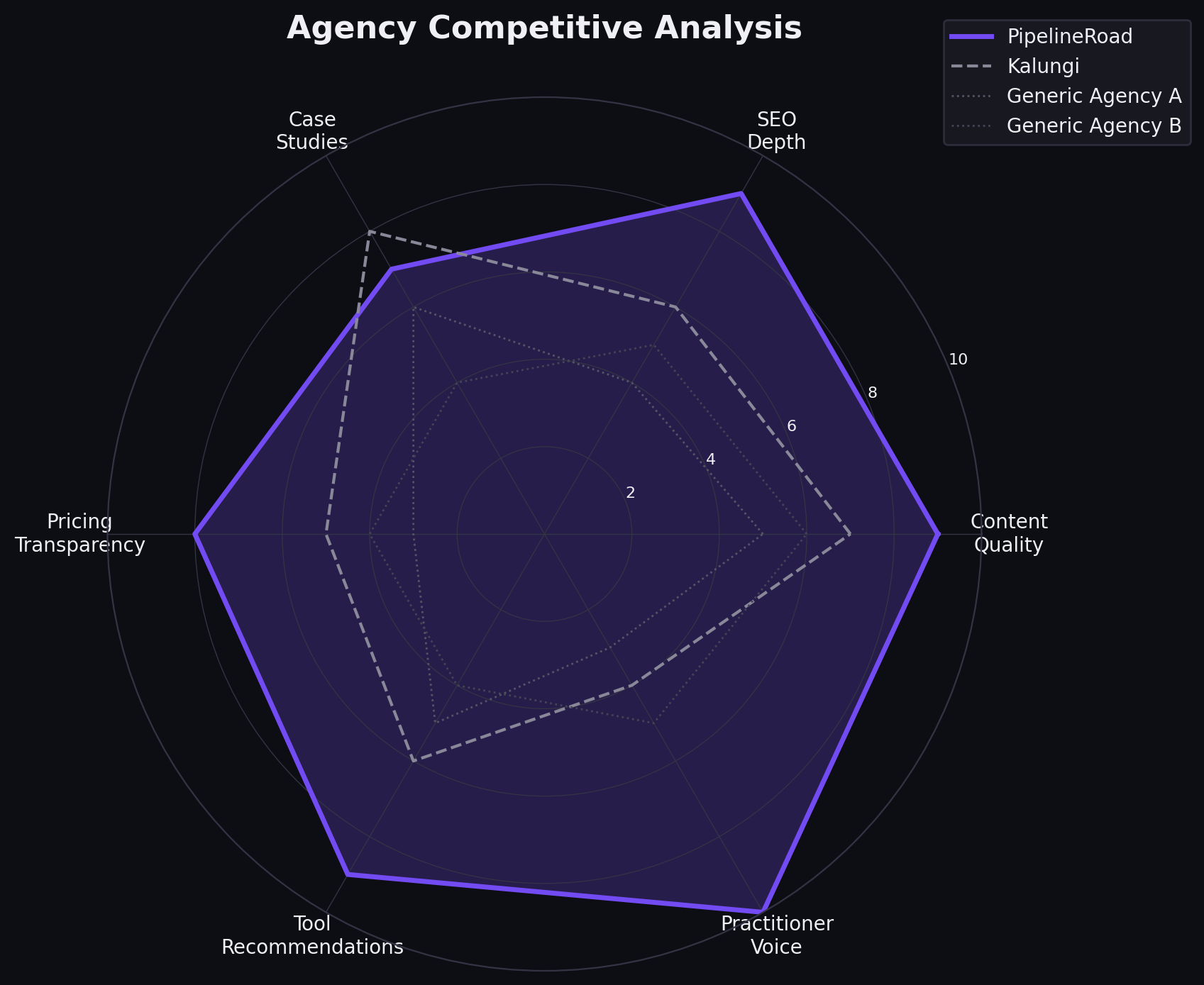
What Doesn’t Work: Agency Red Flags to Watch For
I’ve seen all of these firsthand, as an agency owner, as a client, and as a consultant cleaning up after bad engagements. These patterns consistently lead to disappointment.
”We do everything for everyone”
If an agency serves SaaS companies, e-commerce stores, local businesses, and nonprofits from the same playbook, run. B2B SaaS marketing has specific requirements: long sales cycles, multiple stakeholders, product-led growth considerations, metrics that general agencies don’t understand. An agency that serves everyone is optimized for no one.
No published pricing (at all)
There’s a difference between “pricing varies by scope” (reasonable) and “we won’t give you any indication of cost until you sit through a 45-minute sales pitch” (red flag). If an agency won’t even publish starting ranges, they’re either expensive and don’t want to scare you off, or they custom-price based on what they think you’ll pay. Sometimes both.
Vanity metrics in case studies
“We increased traffic by 400%!” Great. From 100 visits to 400? Or from 100,000 to 400,000? And what happened to pipeline? If an agency’s case studies don’t connect marketing activity to revenue outcomes, they’re either not tracking it or the results aren’t impressive enough to share.
The bait-and-switch staffing model
You meet the senior strategist during the sales process. Brilliant person. Clearly understands your business. You sign. Then you get handed off to a junior account manager who’s been at the agency for three months. This is the number-one complaint about agencies and it’s everywhere. Ask directly during the sales process: “Who will I work with day-to-day after we sign?” and “What’s their experience level?” Then get it in writing.
Long-term contracts with no performance clauses
12-month contracts aren’t inherently bad. But they should include performance benchmarks and exit ramps. If an agency wants a year-long commitment with no milestones or accountability, they’re optimizing for revenue predictability, not your results.
Framework worship
Some agencies are so committed to their proprietary methodology that they can’t adapt when it doesn’t fit. Frameworks are useful as starting points, not straitjackets. If an agency’s answer to every question is “that’s not how our framework works,” you’ll spend months forcing your company into their template instead of building what you actually need.
The Forrester B2B Marketing Survey found that 68% of B2B marketers say their external agencies don’t understand their business well enough to be effective. That number hasn’t improved in three years. The core problem isn’t agency competence. It’s the engagement model. Agencies that operate on a deliverable basis (“here’s your content calendar, here are your ads”) will never understand your business deeply enough. Agencies that embed in your sales pipeline, attend your deal reviews, and measure themselves on your revenue will. The model determines the outcome.
How to Choose the Right B2B SaaS Marketing Agency
Choosing the wrong agency costs you more than money. It costs you 3-6 months of time you can’t get back. Here’s the decision framework I’d use.
Step 1: Define what you actually need
Before you talk to a single agency, answer these:
- What’s broken? Is it traffic, conversion, positioning, pipeline, all of the above?
- What’s your budget? Be honest. If your total marketing budget is $8K/mo, a $15K/mo agency isn’t realistic no matter how good they are.
- What stage are you? Pre-product-market fit, post-PMF scaling, mature optimization. Each stage needs different things.
- Do you need strategy, execution, or both? If you have a VP of Marketing and need execution capacity, that’s different from needing someone to build the entire function.
Step 2: Match agency type to your need
| Your Situation | Best Agency Type |
|---|---|
| No marketing team, need everything | Full-service + fractional CMO (Growigami, Kalungi) |
| Established team, need paid media scale | Performance marketing (Directive) |
| Rethinking entire demand gen approach | Strategic advisory (Refine Labs) |
| Need content and organic growth | Content/SEO specialist (Omniscient, SimpleTiger) |
| Website is the bottleneck | Growth-driven design (Lean Labs) |
| Need lead gen systems | Lead gen agency (Ironpaper) |
| Small budget, need results now | Accessible full-service (Bay Leaf, Growigami) |
Step 3: Run a real evaluation
Once you’ve shortlisted 2-3 agencies:
Ask for references you can actually call. Not the curated ones on their website. Ask for a client who churned and one who stayed. How an agency handles the churn question tells you everything.
Request a sample strategy or audit. Good agencies will give you a free mini-audit or strategic recommendation as part of the sales process. If the free stuff is generic, the paid work will be too.
Clarify the team. Who’s doing the work? What’s their background? Can you meet them before signing?
Understand reporting. What metrics will they report on? How often? Do they connect to your CRM, or do they report in a silo?
Negotiate the contract. Push for month-to-month or quarterly with 30-day notice. If the agency is confident in their work, they shouldn’t need a 12-month lock-in.
Step 4: Set expectations correctly
No agency will transform your pipeline in 30 days. Here are realistic timelines:
- Paid media: First qualified leads in 2-4 weeks. Optimized CPL in 60-90 days.
- SEO and content: Meaningful organic traffic growth in 3-6 months. Pipeline impact in 6-9 months. Companies that invest consistently in content see significantly more organic traffic after 12 months compared to those that start and stop. That consistency piece is what most people underestimate.
- Website redesign: First conversion improvements in 4-8 weeks post-launch.
- Full-service engagement: First pipeline impact in 60-90 days. Full-system optimization in 6 months.
Most agency churn happens at month 3, right before the compounding kicks in. I’ve seen it over and over. A founder hires an agency, gets impatient at week 8 because the organic traffic graph hasn’t hockey-sticked, fires the agency, hires a new one, resets the clock. If you’re going to commit to an agency, commit for at least two quarters. If you’re not willing to do that, you’re not ready for an agency. You need a freelancer for a specific project.
The Bottom Line
There’s no objectively “best” B2B SaaS marketing agency. There’s the best agency for your specific situation, stage, budget, and goals.
If you’re early-stage and need a full marketing function that can move fast without burning through your runway, Growigami and Bay Leaf Digital are strong options. If you want a proven framework and have the budget for a premium engagement, Kalungi delivers. If you need to scale paid media aggressively, Directive is hard to beat. If your entire demand gen philosophy needs rethinking, talk to Refine Labs.
The most expensive mistake isn’t picking the wrong agency. It’s spending 6 months with the wrong agency before admitting it’s not working. Use the evaluation framework above, be honest about what you need, and don’t let anyone sell you a 12-month contract without performance milestones.
If you want to talk through which approach makes sense for your specific situation, reach out to us. We’ll tell you honestly whether we’re the right fit, and if we’re not, we’ll point you to someone who is.
How we researched this: This guide draws on publicly available pricing data, published case studies, Glassdoor and LinkedIn team analyses, client reviews on G2 and Clutch, and our experience working with 40+ B2B SaaS companies over seven years. We also interviewed SaaS founders who have worked with agencies on this list. No agency paid for placement or review. Last updated March 2026.
Further Reading
- Fractional CMO for SaaS - If you are deciding between hiring a CMO and hiring an agency.
- B2B SaaS GTM Strategy - The GTM playbook an agency should help you execute.
- B2B SaaS Content Strategy - What to expect from an agency’s content program.
- B2B SaaS Lead Generation - The lead gen channels an agency should cover.
- In-House Marketing vs Agency - The real cost comparison.
- Agency vs Freelancer - When each model makes sense.
Head-to-Head Comparisons
Want a deeper look at how specific agencies stack up? We wrote detailed comparisons for each:
- Growigami vs Kalungi
- Growigami vs Directive
- Growigami vs Refine Labs
- Growigami vs Bay Leaf Digital
- Growigami vs Ironpaper
- Growigami vs Single Grain
- Growigami vs New Breed
- Growigami vs DemandZen
- Full agency comparison roundup
Frequently Asked Questions
What makes a B2B SaaS marketing agency different from a general marketing agency?
B2B SaaS agencies understand long sales cycles, product-led growth, and the metrics that matter: MQLs, SQLs, pipeline, CAC, LTV. General agencies optimize for impressions and clicks. SaaS agencies optimize for pipeline and revenue. They also understand SaaS-specific concepts like free trial optimization, PLG funnels, expansion revenue, and net dollar retention, things a general agency has never worked with.
How much do B2B SaaS marketing agencies charge?
Most B2B SaaS agencies charge between $5,000 and $30,000 per month depending on scope. Full-service engagements (strategy + execution) typically run $10,000-$25,000/mo. Fractional CMO services are usually $5,000-$15,000/mo. Single-channel specialists (SEO only, paid media only) tend to start at $5,000-$10,000/mo. Always ask about additional costs like ad spend management fees, content production credits, or tool subscriptions.
How long does it take to see results from a SaaS marketing agency?
Paid media can generate leads within 2-4 weeks, with optimized CPL by 60-90 days. SEO and content marketing typically show meaningful organic traffic growth in 3-6 months, with pipeline impact in 6-9 months. Full-service engagements usually show first pipeline impact within 60-90 days. Any agency promising “results in 2 weeks” from organic channels is either misleading you or defining “results” very loosely.
Should I hire an agency or a full-time marketer?
If you need a full marketing system (strategy, content, paid, SEO, design, RevOps), an agency gives you a complete team for less than one senior hire. A senior marketing hire costs $150,000-$200,000/year in salary alone, plus benefits, tools, and management overhead, and they’re still one person. An agency at $10,000/mo ($120,000/year) gives you a team of specialists. If you have an established marketing function and need one specific specialist (a product marketer, a demand gen manager), hire in-house.
What should I look for when choosing a SaaS marketing agency?
Five things: (1) SaaS-specific experience with real case studies showing pipeline and revenue impact, not just traffic. (2) Transparent pricing, at minimum published starting ranges. (3) Full-funnel attribution, not just vanity metrics like impressions or social followers. (4) Willingness to integrate with your CRM and existing tools, not operate in a silo. (5) A clear onboarding process and honest assessment of timeline to results. Avoid agencies that won’t share their process, hide pricing entirely, or rely on proprietary jargon instead of clear communication.
Frequently asked
What makes a B2B SaaS marketing agency different from a general marketing agency?
B2B SaaS agencies understand long sales cycles, product-led growth, and the metrics that matter -MQLs, SQLs, pipeline, CAC, LTV. General agencies optimize for impressions and clicks. SaaS agencies optimize for pipeline and revenue.
How much do B2B SaaS marketing agencies charge?
Most B2B SaaS agencies charge between $5,000 and $30,000 per month depending on scope. Full-service engagements (strategy + execution) typically run $10,000-$25,000/mo. Fractional CMO services are usually $5,000-$15,000/mo.
How long does it take to see results from a SaaS marketing agency?
Paid media can generate leads within 2-4 weeks. SEO and content marketing typically show meaningful organic traffic growth in 3-6 months. Pipeline impact from a full-service engagement is usually visible within 60-90 days.
Should I hire an agency or a full-time marketer?
If you need a full marketing system (strategy, content, paid, SEO, design, RevOps), an agency gives you a complete team for less than one senior hire. If you have an established marketing function and need one specialist, hire in-house.
What should I look for when choosing a SaaS marketing agency?
Look for: SaaS-specific experience with case studies, transparent pricing, full-funnel attribution (not just vanity metrics), willingness to integrate with your CRM, and a clear onboarding process. Avoid agencies that won't share their process or pricing.