Most “best fractional CMO services” articles are written by fractional CMOs ranking themselves first. Kalungi’s version gives competitors three sentences each, buries pricing, and concludes you should hire Kalungi. Shocker.
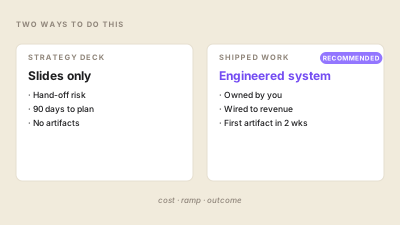
This is a different kind of comparison. I run a B2B SaaS marketing agency. We offer fractional CMO services. But I’ve also hired fractional CMOs, partnered with them, and watched SaaS founders light five figures on fire picking the wrong one. One of our clients came to us after spending $18K/month on a fractional CMO who produced exactly one strategy deck in three months. Eighteen thousand dollars. One deck.
So here’s an honest breakdown of what the fractional CMO market actually looks like in 2026, who does it well, what it costs, and when you shouldn’t hire one at all.
What Is a Fractional CMO?
A fractional CMO is a senior marketing executive who works with your company part-time, usually 10-20 hours per week, at a fraction of the cost of a full-time hire.
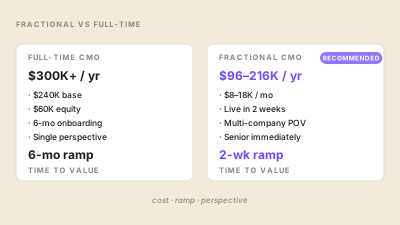
The “fractional” part means you get real CMO-level leadership without the $250K-$400K total compensation package. You’re buying strategic marketing leadership on a time-share model.
The market has exploded. Fractional CMO demand grew roughly 63% since 2022, mostly because SaaS companies realized they needed senior leadership but couldn’t stomach the full-time cost. And here’s the kicker: the average tenure of a full-time SaaS CMO is just 25 months. So you spend 3-6 months recruiting, pay for two years of service, then start over. Fractional eliminates that cycle entirely.
Here’s what a fractional CMO is not, because founders get this wrong constantly:
A consultant advises. A fractional CMO owns outcomes. They sit in your leadership meetings, manage your marketing team or agency relationships, and are accountable for pipeline numbers. They don’t hand you a recommendation and walk away.
An agency executes campaigns. A fractional CMO decides which campaigns to run, how to allocate budget, and what “good” looks like. Different job.
A contractor completes tasks. A fractional CMO sets the tasks, builds the roadmap, and connects marketing to revenue.
The distinction matters because I’ve talked to dozens of SaaS founders who thought they were hiring a strategist and ended up with someone who writes blog posts. Or they hired an “advisor” who shows up twice a month with a slide deck but never touches the CRM. Neither of those is a CMO.
A real fractional CMO functions as a member of your leadership team. They just happen to do it in 15 hours a week instead of 50.
What a Fractional CMO Does Day-to-Day
The biggest gap between expectation and reality with fractional CMO services is the day-to-day. Founders imagine a seasoned executive parachuting in to fix everything. What actually happens depends entirely on the engagement structure.
Here’s what a well-run fractional CMO engagement looks like on a weekly basis:
Week-by-Week Rhythm
Monday (2-3 hours):
- Weekly pipeline review with sales leadership
- Check dashboards: MQL/SQL conversion rates, campaign performance, content pipeline
- Prioritize the week’s focus areas
Tuesday-Wednesday (4-6 hours):
- 1:1s with marketing team members (content, demand gen, product marketing)
- Agency check-ins if external partners are involved
- Review and approve creative, messaging, campaign briefs
- Work on strategic initiatives: positioning refresh, new channel evaluation, ABM program design
Thursday (2-3 hours):
- Cross-functional alignment: product launches, sales enablement needs, customer marketing
- Board/investor reporting prep (monthly/quarterly)
- Competitive intelligence review
Friday (1-2 hours):
- Async updates to CEO
- Content review and approval
- Planning for next week
That’s roughly 10-15 hours. Some fractional CMOs work 20 hours/week for companies in heavier growth phases, like a new product launch, Series B GTM buildout, or a complete marketing overhaul.
What They Own vs. What They Delegate
| Owns Directly | Delegates to Team/Agency |
|---|---|
| Marketing strategy and OKRs | Content creation and publishing |
| Budget allocation | Paid media execution |
| Positioning and messaging | Email campaign builds |
| Vendor/agency management | Social media management |
| Board reporting | Design and production |
| Hiring decisions | SEO implementation |
| Channel strategy | Event logistics |
The fractional CMO is the architect. Everyone else is a builder. If you hire a fractional CMO who’s writing LinkedIn posts and building landing pages themselves, you didn’t hire a CMO. You hired an expensive content marketer.
This is where most engagements go sideways. I’ve seen it repeatedly. The CMO starts taking on execution work because the team is thin, and within two months they’re spending 70% of their time on tasks a marketing coordinator could handle. You’re paying CMO rates for coordinator output.
The test is simple: after 90 days, can your fractional CMO articulate your competitive positioning in one sentence, your top three pipeline channels by ROI, and your CAC by channel? If they can’t answer those questions cold, they’ve been executing, not leading. And you’ve been overpaying for a marketing manager.
Top Fractional CMO Services for SaaS
I’ve evaluated these based on conversations with founders who’ve used them, publicly available information, and my own direct experience where I have it. Full disclosure: we’re on this list, so I’m biased. I debated whether to include Growigami at all, but leaving ourselves off felt more dishonest than putting ourselves on with a transparent disclaimer.
Every provider here has strengths. The question is which one fits your situation.
1. Growigami
Website: growigami.com/fractional-cmo-saas
Quick backstory: I spent four years at Kalungi (2019-2023). Joined as one of their first Marketing Leaders running fractional CMO engagements, sold new business, supported their clients, sat on the leadership team, eventually became CRO. Great company, learned a ton about how SaaS agencies actually operate from the inside. But over those four years I kept watching SaaS founders struggle with the same thing: they needed fractional CMO leadership but couldn’t afford the $15K-$20K/mo price tag that comes with a full agency team. Capital was getting tighter, SaaS wasn’t the 2020-era money printer anymore. So Bruno and I left to build Growigami around a different model.
We combine fractional CMO leadership with a full execution team. Strategy, content, paid, design, video, all under one roof. The CMO isn’t an advisor who hands off a strategy doc and disappears. They work alongside a team that actually builds the campaigns, writes the content, and runs the ads. And we run AI-native processes instead of the traditional agency workflow where everything takes three weeks and four approval rounds.
Pricing: $5,000-$15,000/month depending on scope and hours. That includes execution team access, no separate agency retainer on top.
Best for: B2B SaaS companies at $1M-$20M ARR that need both strategic leadership and execution capacity. Especially strong for companies that don’t have an internal marketing team yet.
The trade-offs are real. We’re a smaller firm. If brand recognition matters to your board (“we hired Chief Outsiders”), we’re not that. And if you already have a strong internal team and only need a strategic advisor, you’re paying for execution capacity you don’t need. We’re also purely B2B SaaS. B2C or e-commerce, look elsewhere.
2. Kalungi
Website: kalungi.com
Full transparency: this is where I came from. I spent four years at Kalungi (2019-2023), ran client engagements as fractional CMO, sold new business, sat on the leadership team, and eventually became CRO. So I’m not evaluating them from the outside.
Kalungi has built a genuine SaaS marketing engine. Their T2D3 framework (triple, triple, double, double, double) is well-known in the PLG world, and they practice what they preach with their own content marketing. They pair a CMO-level strategist with a team of specialists and prefer full-service engagements over CMO-only deals.
The quality of their thought leadership is strong. The team knows the SaaS space deeply. From having been on the inside, I’ll say the process works extremely well when your go-to-market fits the framework. Where I saw friction was with founders whose situations didn’t map cleanly to T2D3. The methodology can feel rigid when you need to deviate. At $15,000-$30,000/month for a full engagement, you’re paying a premium, and that pricing is part of why Bruno and I left to build something more accessible. Not a knock on the quality. It’s genuinely good. It’s a question of what the market can bear in 2026.
3. Chief Outsiders
Website: chiefoutsiders.com
The biggest player in the space. 100+ fractional CMOs in their network, operating since 2009. They match you with a CMO from their roster based on industry and stage. Think of them as the staffing agency model applied to fractional executive leadership.
The size is both their strength and their weakness. With 100+ CMOs, you’ll almost certainly find someone with experience in your exact niche. A SaaS founder I know got matched with a CMO who had previously run marketing at a company selling into the same buyer persona. That kind of precision is hard to replicate at a smaller firm.
But 100+ CMOs also means quality varies. A lot. Some are exceptional operators with deep SaaS chops. Others are generalists who spent most of their career in manufacturing or healthcare and are now dabbling in SaaS. You’re rolling the dice on the match. And they don’t provide execution support, so you’ll need your own team or a separate agency to implement whatever strategy the CMO develops.
Pricing runs $10,000-$20,000/month, typically structured as a two-day-per-week engagement.
4. CMOx
Website: cmox.co
Casey Slaughter Stanton’s firm takes a different angle. They train and certify fractional CMOs using a proprietary methodology, then either place them with clients or have them work through CMOx directly. If you hire through their network, you’re getting someone who went through the program.
The consistency of methodology is a real advantage. You know what you’re getting. The downside is that some CMOs in the network are early in their fractional careers. The training provides a baseline, but it’s not a substitute for 15 years of marketing leadership experience. Pricing is more accessible at $5,000-$12,000/month, which makes them a solid option for companies in the $1M-$5M range that aren’t ready for a Chief Outsiders-level engagement.
5. Authentic Brand
Website: authenticbrand.com
Minneapolis-based, strong in mid-market B2B. Their differentiator is what they call “marketing activators,” essentially execution support layered on top of the fractional CMO. It’s a similar insight to what we do at Growigami: strategy without execution is just a deck.
They’ve carved out a solid niche in the Midwest startup ecosystem. If you’re a B2B company (not exclusively SaaS) in the $5M-$50M range and want that strategic-plus-tactical blend, they’re worth evaluating. Less SaaS-specific than us or Kalungi, and their geographic footprint is regional, which matters if you want someone embedded in the SF or NYC SaaS ecosystem. Pricing runs $7,000-$15,000/month.
6. Marketing Eye
Website: marketingeye.com
Global firm with operations in both the US and Australia. They’re one of the more affordable options at $3,500-$10,000/month, which makes fractional CMO services accessible for earlier-stage companies that balk at $15K/month price tags.
I’ll be blunt. I’ve heard mixed things. Some founders I’ve spoken with felt they got a more junior experience than expected at the CMO level. That tracks with the lower price point, and it’s not necessarily a dealbreaker if your needs are straightforward. But if you’re expecting a seasoned executive who’s run marketing at a $50M SaaS company, calibrate your expectations.
7. Marketri
Website: marketri.com
Led by Deb Andrews, Marketri is heavily data-driven with a focus on marketing ROI measurement. Good for companies where the CFO is scrutinizing every marketing dollar, because their framework speaks that language fluently.
They work primarily with B2B technology and professional services firms at $5M-$50M revenue. Not SaaS-specific, and their team is smaller, which limits execution capacity. East Coast focused. Pricing runs $8,000-$15,000/month with structured engagements and clear milestones.
8. Hawke Media
Website: hawkemedia.com
Hawke is a different animal. They’re a full-blown LA-based agency, venture-backed, with fractional CMO as one service line among many. The scale is impressive. They can handle complex multi-channel campaigns that smaller fractional CMO firms can’t touch.
Here’s the thing, though. Their DNA is DTC and e-commerce, not SaaS. The “fractional CMO” role can feel more like a senior account strategist managing your engagement than a true marketing executive sitting in your leadership team. And execution costs add up fast. The CMO retainer is $4,000-$10,000/month, but each execution channel (paid, content, email) bills separately at $3,000-$10,000+ per month. You can hit $25K/month quickly.
9. Ignite Visibility
Website: ignitevisibility.com
Similar story to Hawke. Ignite is a San Diego agency known for SEO and paid search that bolted on fractional CMO as a service. If your primary growth lever is organic and paid search and you want a CMO who can also quarterback channel execution, that’s their sweet spot.
The fractional CMO offering is an add-on, not the core business, which means it may not get the same attention as their bread-and-butter services. Less experience with SaaS-specific GTM motions like PLG or sales-assisted models. Pricing is $5,000-$15,000/month, often bundled with SEO or paid media retainers.
Fractional CMO vs Full-Time CMO vs Agency
This is the real decision. Before you evaluate individual fractional CMO services, decide whether fractional is even the right model.
| Factor | Fractional CMO | Full-Time CMO | Marketing Agency |
|---|---|---|---|
| Monthly cost | $5,000-$15,000 | $17,000-$30,000 (salary + benefits) | $5,000-$25,000 |
| Annual cost | $60,000-$180,000 | $250,000-$400,000 (with equity/bonus) | $60,000-$300,000 |
| Hours/week | 10-20 | 40-50+ | Varies by retainer |
| Strategic ownership | Yes | Yes | Limited |
| Execution capacity | No (unless bundled) | Manages team | Yes |
| Ramp-up time | 2-4 weeks | 3-6 months | 2-4 weeks |
| Commitment | Month-to-month or quarterly | 12-18 months realistic minimum | Month-to-month or annual |
| Company knowledge | Shared across clients | Fully dedicated | Shared across clients |
| Risk if it’s a bad fit | Low (easy to exit) | High (severance, lost time) | Medium |
About 42% of SaaS companies between $2M-$10M ARR now use some form of fractional marketing leadership. That was 18% in 2021. This isn’t a trend anymore. It’s a structural change in how growth-stage companies build marketing functions.
When Each Model Wins
Hire a full-time CMO when:
- You’re above $20M ARR and marketing is a board-level function (see our enterprise SaaS marketing playbook)
- You have a 5+ person marketing team that needs daily leadership
- You can afford $300K+ total comp and are willing to spend 3-6 months on the search
- Marketing is your primary growth engine (not product-led or sales-led)
Hire a fractional CMO when:
- You’re at $1M-$20M ARR with product-market fit
- The founder is still the de facto head of marketing
- You need senior leadership but can’t justify (or find) a full-time CMO
- You want to build the marketing function before hiring a full-time leader
Hire an agency when:
- You have a clear strategy but need hands to execute it
- Your bottleneck is production capacity, not strategic direction
- You need specialists (SEO, paid media, content) without hiring them full-time
Combine a fractional CMO with an agency when:
- You need both strategic direction and execution capacity
- You want a single point of accountability for marketing outcomes
- You’re building toward a full-time hire but aren’t ready yet
- This is the marketing-as-a-service model that Growigami runs
How Much Does a Fractional CMO Cost?
Let’s get specific. These are the pricing ranges I’ve seen across 30+ fractional CMO engagements in B2B SaaS:
Pricing Tiers
Advisory-only ($3,000-$7,000/month):
- 5-10 hours/week
- Strategic guidance, monthly roadmap, bi-weekly calls
- No execution, no team management
- Best for: founders who can execute but need a sounding board
Standard fractional CMO ($7,000-$12,000/month):
- 10-15 hours/week
- Full strategic ownership, weekly cadence, team/agency oversight
- Some hands-on work (positioning, messaging, planning)
- Best for: most SaaS companies between $2M-$10M ARR
Senior/executive fractional CMO ($12,000-$20,000/month):
- 15-20 hours/week
- Board-level involvement, investor relations support
- Often includes team building (hiring your first marketing hires)
- Best for: Series B+ companies building a marketing org
Fractional CMO + execution team ($10,000-$25,000/month):
- CMO leadership plus dedicated execution resources
- Content, design, paid media, email, all included
- Single invoice, single point of accountability
- Best for: companies that need the whole marketing function outsourced
- This is how Growigami’s agency model works
Hourly vs. Retainer
Some fractional CMOs charge hourly ($200-$350/hour). I’d avoid this model for three reasons:
- Misaligned incentives. Hourly billing rewards time spent, not outcomes achieved. A great CMO should get your MQL pipeline running in fewer hours, not more.
- Budget anxiety. When you’re paying by the hour, you hesitate to call your CMO with a quick question. That kills the relationship.
- Unpredictable costs. A month with a product launch might cost $12,000. A quiet month might cost $4,000. Budgeting becomes guesswork.
Retainer-based engagements (fixed monthly fee for defined hours and outcomes) give you predictability and make your CMO a partner, not a vendor.
The Hidden Cost: Execution Gap
Here’s the number that doesn’t show up in fractional CMO pricing: the cost of actually implementing their strategy.
A fractional CMO at $10,000/month will hand you a marketing plan. Great. But someone needs to write the content, build the landing pages, run the ads, and set up the email sequences. If you don’t have an internal team, you need an agency, and that’s another $5,000-$20,000/month.
Total cost of fractional CMO plus separate agency: $15,000-$30,000/month.
This is the dirty secret of the fractional CMO industry. Most fractional CMO firms don’t talk about it because acknowledging it undermines their pricing model. But I’ve watched it play out too many times. A founder signs a $10K/month fractional CMO contract, gets a beautiful 40-page marketing plan, and then realizes they have nobody to execute any of it. The plan sits in a Google Drive folder gathering dust. A strategy with no one to implement it is a PowerPoint presentation, not a marketing program.
That’s why the bundled model (CMO plus execution team under one roof) often makes more economic sense at the growth stage. You pay one provider $10,000-$15,000 instead of $20,000-$30,000 split across two.
When to Hire a Fractional CMO
Not every SaaS company needs a fractional CMO. Here’s how I’d think about it, based on watching this go right and go very wrong across dozens of engagements.
You’re Ready If:
You have paying customers who love the product, but growth depends on the founder’s Rolodex. Every deal comes from the CEO’s network or a lucky inbound. Marketing is a series of one-off experiments. There’s no coherent strategy tying them together. Sound familiar?
You’re spending money on marketing and can’t tell if it’s working. You have an agency or some contractors, but nobody is connecting spend to pipeline. When the board asks “how many SQLs did marketing generate last quarter?” you stall.
You, the CEO, are spending 10+ hours a week on marketing tasks. Writing blog posts. Managing an agency. Approving ad creatives. You’re doing a CMO’s job poorly while neglecting your actual job. A fractional CMO takes ownership of your marketing strategy and the entire marketing function. You get those hours back.
You’re between $1M and $20M ARR. Below $1M, you probably need a hands-on marketing generalist, not a CMO. Above $20M, hire full-time. The fractional sweet spot is the middle.
You’ve been burned by a marketing agency. Agencies without strategic oversight often churn through tactics with no coherence. A fractional CMO gives your agency direction and accountability. They translate between the CEO’s vision and the agency’s execution.
You’re Not Ready If:
You don’t have product-market fit. Still iterating on the product with inconsistent revenue? Marketing leadership is premature. You need customer discovery, not a marketing roadmap.
You want someone to “do the marketing.” A CMO is a leader, not a doer. If you need someone writing emails, posting on LinkedIn, and building landing pages, hire a marketing manager or an agency.
You won’t invest in execution alongside the CMO. A CMO without a team is a strategist writing memos nobody reads. Budget for both.
Your leadership team can’t commit to a weekly marketing sync. If the CEO can’t block 30 minutes per week, the engagement will drift. I’ve seen it happen. Marketing leadership requires access to leadership. No access, no results.
Red Flags When Hiring a Fractional CMO
I’ve seen good engagements and terrible ones. The terrible ones always had warning signs from day one. Here are the patterns I keep seeing.
They can’t tell you what the first 30 days look like.
Ask them. If you get a vague “it depends” with no structure, run. A competent fractional CMO can outline their onboarding approach without a script: audit current state, review data, interview stakeholders, assess team capabilities, deliver a competitive positioning framework and 90-day roadmap. They’ve done it before. They should be able to describe it from memory.
They’ve never worked at your stage or with your sales motion.
I talked to a founder who hired a fractional CMO with 20 years of enterprise marketing experience. The company was a $3M ARR product-led SaaS tool. The CMO spent the first month trying to build an ABM program targeting Fortune 500 accounts. Complete mismatch. Ask for examples at your stage, your ACV, your go-to-market motion. If they can’t name specific companies, they’re stretching.
The first conversation is about tactics.
“We should run LinkedIn ads.” “You need more blog content.” That’s a channel specialist in a CMO costume. A real CMO starts with positioning, competitive landscape, and highest-leverage growth opportunities. Tactics come after strategy, always.
They dodge the reference question.
Every reputable fractional CMO should have 3-5 founders who’ll vouch for them. If they only have references from massive enterprises when you’re a $3M startup, that’s a mismatch worth questioning.
The contract has no defined outcomes.
“Improve marketing” isn’t an outcome. A good engagement defines pipeline contribution targets, metrics cadence, 90-day milestones, and what “done” looks like. If the contract just says “X hours per month,” you’ll be evaluating vibes instead of results.
They need a 12-month lock-in.
Fractional work should be low-commitment. Quarterly with the option to extend is standard. If someone needs a year-long contract, they’re not confident they’ll earn the renewal.
They’re juggling five or more clients.
Most fractional CMOs work with 2-4 clients. Beyond four, attention drops off a cliff. Ask how many active clients they have. Five or more is a problem.
How to Get the Most from Your Fractional CMO
Hiring is one decision. Getting value from the engagement is another. Here’s what separates the companies that get 10x ROI from those that cancel after three months.
1. Give Them Real Access
Access to your CRM, analytics, financial data, and leadership team. A fractional CMO operating on partial information will give you partial results. They need to see your pipeline, your churn data, your revenue by segment. The same data a full-time CMO would have. Don’t hold back because they’re “part-time.”
2. Establish a Weekly Cadence on Day One
Set a recurring 30-minute weekly sync between the CMO and the CEO (or whoever owns the revenue number). This meeting is sacred. Cancel it, and the engagement drifts. I’ve watched engagements die because the CEO kept rescheduling the weekly sync. Three missed meetings and the CMO is operating in the dark.
3. Define the First 90-Day Outcomes Together
Don’t let the CMO disappear for a month to “develop the strategy.” Co-create the 90-day plan in the first two weeks. Agree on 3-5 measurable outcomes. Review progress weekly.
4. Empower Them to Make Decisions
If every decision requires CEO approval, you don’t have a CMO. You have an advisor. Define their authority: budget thresholds they can approve, hires they can make, vendors they can evaluate. Then actually let them lead.
5. Connect Them Directly to Sales
Marketing-sales alignment is where fractional CMO engagements either fly or die. Your fractional CMO should be in the pipeline review, hearing sales calls, and understanding why deals close or don’t. If they’re isolated in a “marketing silo,” they’ll optimize for vanity metrics while pipeline flatlines.
6. Set a 90-Day Evaluation Point
At 90 days, you should see a clear strategy documented and in execution, marketing KPIs established and tracked, team or agency partners aligned and productive, and early pipeline indicators trending upward. If none of that has happened, it’s not working. Cut it.
7. Plan the Transition
The best fractional CMO engagements end one of two ways: you hire a full-time CMO (and the fractional helps recruit and onboard them), or you scale the fractional engagement into a longer-term marketing-as-a-service partnership. Either way, plan for it from day one.
The Bottom Line
The fractional CMO market has grown up. Five years ago, “fractional CMO” meant a retired marketing executive doing consulting on the side. Today, it’s a real leadership model that hundreds of SaaS companies use to bridge the gap between founder-led marketing and a full-time executive hire.
The right choice comes down to three things:
- Your stage. $1M-$20M ARR is the sweet spot for fractional.
- Your needs. Strategy only, or strategy plus execution?
- Your budget. $5K-$15K/month for the CMO, plus execution costs unless bundled.
If you want strategic leadership with an execution team that actually builds the campaigns, that’s what we do at Growigami. But I’d genuinely rather you hire the right fractional CMO for your situation, even if it’s not us, than waste three months on the wrong fit. I’ve seen what three wasted months costs a growth-stage company. It’s not just the retainer. It’s the lost pipeline you’ll never get back.
The most expensive marketing mistake isn’t hiring the wrong agency. It’s operating without senior marketing leadership during the years when your growth trajectory is being set.
Related Comparisons
- Fractional CMO vs Full-Time CMO - The detailed cost and impact breakdown.
- Fractional CMO vs Marketing Agency - When each model wins.
- In-House Marketing vs Agency - The build vs buy decision.
- Best B2B SaaS Marketing Agencies - If you decide an agency is the better fit.
- HubSpot Agency vs Full-Service Agency - For HubSpot-centric companies weighing options.
Frequently asked
What does a fractional CMO actually do?
A fractional CMO provides part-time senior marketing leadership, typically 10-20 hours per week. They own strategy, manage your team or agencies, set OKRs, and report to the CEO. Everything a full-time CMO does, just not five days a week.
How much does a fractional CMO cost?
Expect $5,000-$15,000 per month for B2B SaaS. Some charge $200-$350/hour. Compare that to a full-time CMO at $250K-$400K all-in, and fractional runs about 70-80% cheaper.
When should a SaaS company hire a fractional CMO?
When you have product-market fit and early traction but the founder is still doing all marketing. Typically $1M-$20M ARR companies that can't justify a $300K+ hire yet.
Fractional CMO vs marketing agency, which is better?
A fractional CMO leads strategy but usually doesn't execute. An agency executes but may lack strategic depth. The strongest model combines both. That's what Growigami offers.